ictus

ictus

Thursday, 14 June 2012

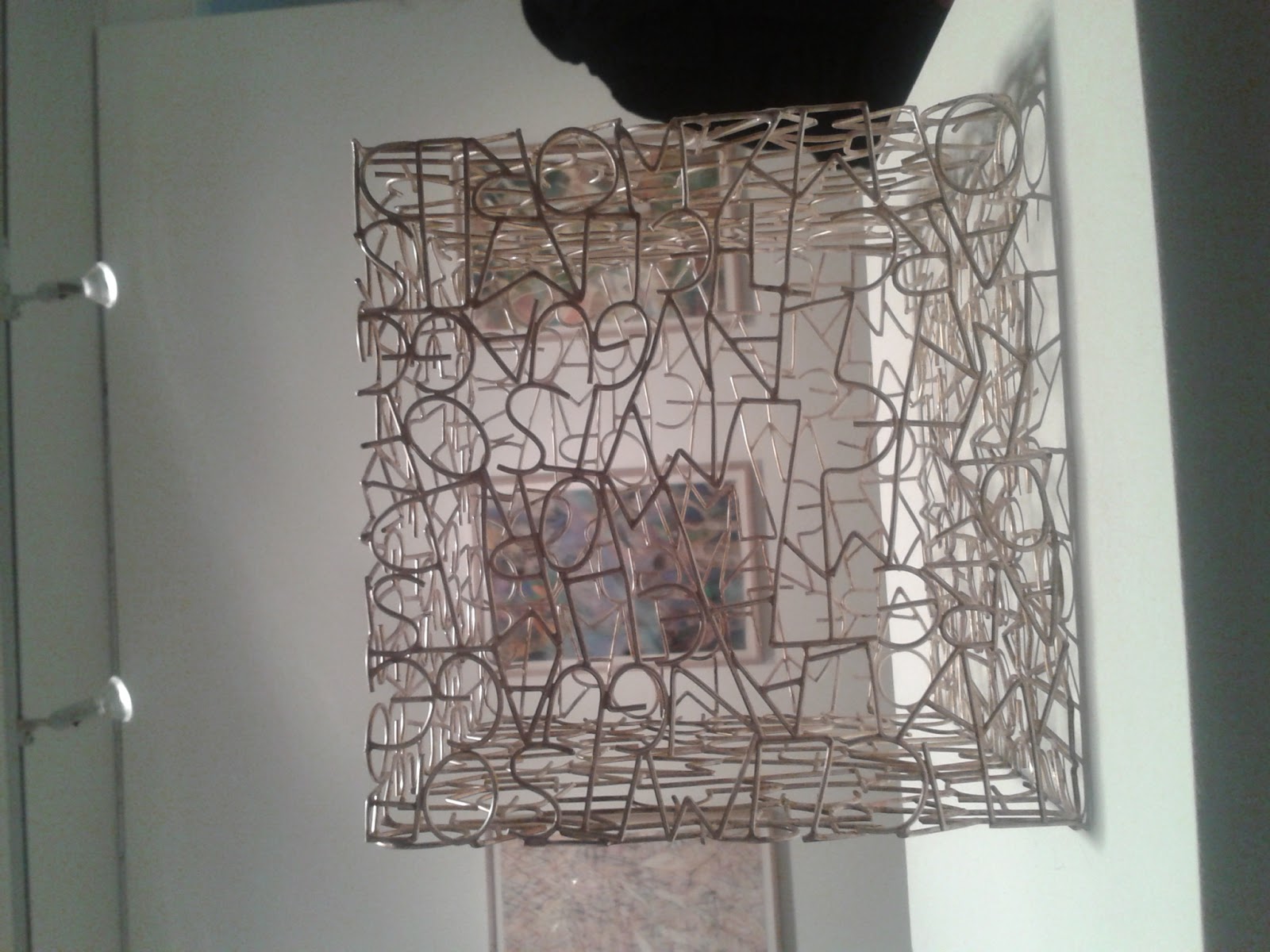
The Limits of Our Language Are the Limits of Our World


Another word-cube from Tom Philips, this time with text from Wittgenstein, from his new exhibition at Flowers Gallery in Shoreditch.

Monday, 11 June 2012

Francophile/Anglophobe

                                                   
   Marvellous Jubilee-evading break in south-west France over the half-term exploring the countryside and villages around Carcassonne with friends, venturing into Les Montagnes Noirs and the foothills of the Pyrennees. The landscapes are starkly dramatic, sparsely-populated, alive with birds and flowers: the weather was beautiful, hot yet breezy. Well-cooked, locally-grown food - accompanied by decent wine and the odd pastis or two - were never far away.
    Deflating, then, to return to work today in chilly persistent rain and wonder what the hell I'm doing in this over-cramped, polluted, hate-infested looney-bin of a city within a country that has not so much gone to the dogs as to the wolves and hyenas, with an amoral blowhard at its helm who's too busy "chillaxing" to notice he's left his 8-year old child behind in the pub.
    I was perversely cheered, after getting home wet and exhausted as though my holiday had never happened, to read this remorseless indictment of our pitiful "sinking island", suggesting that as well as being culturally and politically bankrupt, we are also in terminal decline in terms of power and status:

 "In the hundred years from 1914 to 2014...the UK will have declined from pre-eminent global superpower to developing country, or "emerging market". The symptoms of this vertiginous plunge in the world's rankings are already starkly apparent: a chronic balance of payments deficit, a looming shortage of energy and food, a dysfunctional labour market, volatility in economic growth and a painful vulnerability to external events."
                                                                    (from 'Little Britain' by Larry Elliott & Dan
                                                                       Atkinson, The Guardian Weekend 09.06.12)

Saturday, 2 June 2012

Colossal Rearrangements: Katerina Brac by Christopher Reid

                                                               
   A comment made by Todd Swift the other week at the end of a hyperbolic post about Jon Stone's new volume - "English poetry was perhaps last this differently, oddly smart with Christopher Reid's Katerina Brac" - sent me back to the book in question to check for myself if it was as seminal as Todd implies.
    To be honest, I've never given Reid's work much consideration. I confess to being guilty of lumping him glibly in with his fellow Martian, Craig Raine, whose characteristic early poetry seems to me now as much of an outdated 80's fad as the Sinclair C5 and the ZX Spectrum (no doubt some Hoxton retromaniac out there will tell me that these are now the height of cool...) Worse, its over-reliance on  flashy, gimmicky tropes at the expense of all other components of poetic meaning or emotional/intellectual/social resonance seems reflective both of the design-over-content ostentation prevalent during the decade and even of the deregulating,brashly acquisitive spirit of Thatcherism underscoring it. (Worse still, Raine continues to write in more or less the same, clever-tricksy manner today.)
    Although Reid's first two volumes seemed to be vying with Raine for who could come up with the silliest, most fanciful metaphor (a weightlifter compared to "a human telephone", indeed!), there were always more interesting undercurrents at work even in his most affectedly Martian display. Titles like 'Academy of the Aleatoric' and ' Holiday from Strict Reality' flag up the clear influence of Wallace Stevens, unusual enough for a young English poet of Reid's generation: viewed in the light of the "essential gaudiness" of Stevens' poetry, its linguistically playful dialogue between metaphysical speculation and "things as they are", we begin to discern a persistent philosophical vein in Reid that goes some way to justifying his ludic observational jugglings. It's in this, moreover, that he departs from Raine, whose poems are largely idea-averse, his similitudes amounting to visual puns serving an ultimately descriptive, realist purpose which on scrutiny unravels to a bland thinness of content (the self-defeating aporia of A Martian Sends a Postcard Home, for example, is that why should the recipient know what a mechanical bird or tracing paper is if he doesn't know what a book or mist are); whereas Reid in fact seems more concerned (like Stevens) with the epistemology of seeing or apprehending an ever-shifting reality, and how this is figured in poetic language.
    If the early Reid falls drastically short of the scope and depth (not to mention the formal mastery) of Stevens, he was at least mindful enough of the limitations of Martianism to attempt a more sophisticated mode of ostranenye in his third volume Katerina Brac (1983). While the sustained use of a hetronymic persona links Reid (via Hill's Sebastian Arruruz and Middleton's Herman Moon) back to the Pound of Hugh Selwyn Mauberley and Homage to Sextus Propertius, his complex elaboration of an East European poet writing during the time of Communism is refracted through several layers of equivocating distance even these distinguished forebears didn't employ, although the deliberate anachronisms and mistranslations of Propertius might have given Reid his starting-point. 
    The maladroit translationese of Katerina Brac fosters an off-kilter, wonky manner and rhythm that work in two ways: firstly, as a subtle parody of the often less than felicitous attempts to 'english' East European poets during what Ted Hughes called the "unique tidal wave of poetry translation that swept through English in the sixties and seventies". Few could doubt that this bringing-across of poets like Holub, Joszef, Popa, Celan, Herbert, Brodsky and Milosz (largely promulgated by Hughes and his friend Daniel Weissbort through Modern Poetry in Translation) amounted to an enormously important phenomenon; few also would dispute that a particular overfamilar style - often clunky and ungainly - grew out of the boom (it certainly fed into the purposefully "uglified" poetry of Crow). Secondly, Brac's wryly not-quite-correct-English, intensified by the inclusion (no doubt under the influence of the state censor) of fragments of ridiculous officialese, serves a defamiliarising function which subverts the totalitarian construct of reality she finds herself in. 
    These quirky, ironic observations on love, history and identity might bring to mind the whole tragic lineage of 20th Century poets who struggled to maintain their writing in the midst of brutal suppression and the obligation to conform to "social realist" tenets of literary value (not least Tsvetaeva, Ahkmatova and Ingeborg Bachmann), but also transcend their (imagined) moment by being rueful insights as resonant to a contemporary audience as to an earlier one. The task of confronting a received and politically-devious state-reality is a constant, Reid seems to imply; especially at the time of the volume's composition when Thatcherite policy was leaning towards a reassertion of top-down hegemony.
    With this task (gesturing back towards a Stevensian philosophy) goes the need to recreate a more open-ended and fluid sense of the real through the unpindownable, unlegistated ambivalences of poetic language, like the "pale-blue butterflies" of Katerina's first poem, suggesting "this would be the perfect time/to mend the whole of one's life"; or later in the poem the summer thunder that's like "colossal rearrangements/somewhere at the back of the mind".

Wednesday, 16 May 2012

The Night Keeper

Hunger transfigured you, reduced
you to your own bleak wraith. It animalised
the pious among us, and enflamed
savagery in the worst. My stomach
would wake you with aggrieved whale-song.


The night-keeper, for a cut, neglected
the main gate and we stole in,
secreting honed implements. Which cage
first? you urged: I poised the skeleton-
key, like the tuning-fork of our greed.


But Claude the historian clamped
my shoulder. Famished souls, granted
release and meat, have sometimes failed
to survive their too-eager wolfing. The
irony! he simpered, unhinged from his fast.


So we launched off small, in the Rodent
House, doing as the Romans
did, with raw dormice and gerbils as toothsome
amuse-bouches. Relief and revulsion
conjoined in unanimous tears.


As Victor the arsonist stoked
litter-bin braziers, we delved for bulkier
appetisers: you potted a brace
of dreaming marmoset, I bagged
an iguana and several boomslangs
braceleting my wrist in the dark.


Skinned and skewered by Camille
the butcher, they fattened the ranks
of coypu and wallaby, ibis
and ibex, already sizzling on spits,
wafting their symphony of odours...


We siezed on the flesh like hyenas,
rending hanks to gorge. But these were mere
hors-d’oeuvres: the orgy magnified
as night staggered on and locals thronged,
woken from meat-dreams by the reek of meat.


If hunger’s a delirium, so too
is sudden satiety after famine:
you giggle tipsily, hardly
crediting how sublime an underdone
tapir’s haunch can taste, or the devilled brain
of a sloth. But more and more citizens
clamoured in, lusting for a bite,


and more and more creatures fell victim:
I recall a mob with ropes and hatchets
felling the giraffes like a teetering pine-grove;


a clan of Congolese mountaineering
up an elephant to dismantle it
with their machetes, children darting
inside its gouged abdomen
to hack out the heart and viscera.


Devouring that still-pulsing bellows
of blood, they believe they inherit
the elephant’s soul, his vital animus.


Coming round next morning, sprawled
in the stable of what were probably
moose, the soul of every beast I consumed
bore down on me, their every essence
possessing my body, pleading their unsaid
grace. As deathly heartburn
assailed me you stumbled in, horror-struck:


‘The night-keeper tricked us – he eats
no meat. He’s locked us up inside the zoo.’


Footnote: “He stumbled into a city that was starving to death – the people had even been reduced to eating the animals in the zoo” Rimbaud: The Double Life of a Rebel, Edmund White.


(First published in Long Poem Magazine 7)

Wednesday, 9 May 2012

Haunted Weather


Best known for their emasculatingly satiric remoulding of 'Money (That's What I Want)' and subsequently written-off as what Dave Lee Travis used to call a 'one hit wonder', The Flying Lizards actually numbered as a member the seminal musicological theorist David Toop, a fascinating reflective monograph of whom- written by the excellent Simon Reynolds - may be read in the just-passed April edition of The Wire. This bass-driven tune proves that The Flying Lizards were more than just a post-modern frippery.

Saturday, 28 April 2012

Stop Your Sericulture


 Check out this early manifestation of the Human League, showing how their sound (so different on record) came out of the mid-70s proto-Industrial sound of Cabaret Voltaire, Throbbing Gristle and later Krautrock as much as out of the cleaner electronica of Kraftwerk.
     Martyn Ware still had a moustache and wore a shiny glam-shirt! They didn't have sequencers yet and playing one-handed synth-lines in time with a taped rhythm-track could be tricky! Phil Oakey looks a bit like Javier Bardem's psychotic killer in No Country for Old Men and furrows his brow singing one of the least sensical lyrics ever penned- Buddha protesting against the death of silkworms ("blameless victims") to make silk? 
  Granada TV's photo-inserts are also baffling - is the old lady whose face looms up an arch-sericulturalist or merely Oakey's nan? Is the mushroom-cloud image a suggestion that the "slaughter" of silkworms is an atrocity on a level with the bombing of Hiroshima or that nuclear destruction is what any nation that approves sericulture deserves?
     But somehow a brilliant track even so.

Sunday, 22 April 2012

Etching On Perspex


Saw this today at the London Print Fair at the RA. Would you pay three grand for an interesting visual twist on Mallarme's Un Coup de Des?
    The show was enjoyable,though; a beguiling array of prints by everyone from Hogarth and Cruikshank up to Lucian Freud and Gilbert & George. I even spotted a print of the Durer etching of St Jerome which Josipivici interprets so articulately in Whatever Happened to Modernism? (Simon Turner wrote such a good post on this book recently that I felt I didn't need to.)
   I was lucky enough to meet Stephen Stuart-Smith of Enitharmon Books, who had a stall presenting their own selection of prints. Having lost their Arts Council last year, the good news is that this important poetry imprint is apparently now doing better than ever. 

Friday, 20 April 2012

Stumped by the Form

    Todd Swift wrote an interesting post recently about the new Penned in the Margins anthology Adventures in Form. A few people commented and I thought it was going to turn into a much-needed debate about the relevance and function of poetic form in a time when a kind of unpremeditated, invariably autobiographical free-verse enlivened with phrase-making and perhaps a few clever similes has become the norm for the majority of up-and-coming poets (although this anthology's emphasis on poems written under strictures and restraints suggests the resurgence of an alternative,Oulipan tendency.)
      Before I got round to contributing (and not, I hasten to add, that I'm advocating a New Formalist-type return to an inflexible use of rhyme and metre), Eyewear had moved on but this passage from a recent article (from a psychologist's angle) seemed highly pertinent, inferring how without a well-honed sense of form poetry can become facile and un-inventive:

"The constant need for insights has shaped the creative process. In fact, these radical breakthroughs are so valuable that we've invented traditions and rituals that increase the probability of an epiphany, making us more likely to hear those remote associations coming from the right hemisphere. Just look at poets, who often rely on literary forms with strict requirements, such as haikus and sonnets. At first glance, this writing method makes little sense, since the creative act then becomes much more difficult. Instead of composing freely, poets frustrate themselves with structural constraints. Unless poets are stumped by the form, unless they are forced to look beyond the obvious associations, they'll never invent an original line. They'll be stuck with clichés and conventions, with predictable adjectives and boring verbs. And this is why poetic forms are so important. When a poet needs to find a rhyming word with exactly three syllables or an adjective that fits the iambic scheme, he ends up uncovering all sorts of unexpected connections; the difficulty of the task accelerates the insight process."
          (from 'The Neuroscience of Bob Dylan's Genius' by Jonah Lehrer, Guardian 6.4.12)
  
  Following this line of thought, poets who complain of writer's block should realise that the block is the writing and endless rewriting: it's what you must work gradually through to get to the poem inside, as surely as a sculptor chisels away at his or her stone-slab with a blind, intuitive sense of the shape he or she wants hidden within.
    Perhaps as gradual as the prisoner in The Shawshank Redemption who - day by day by day - chips an escape-route through his cell-wall with a teaspoon. Perhaps the sign of having written a genuine poem (where internal and formal compulsions finally meet) is this sense of breaking-through the very constraints you have set yourself.

Saturday, 14 April 2012

Day of Hope

                                                            
  My review of The Collected Poems of Hope Mirrlees edited by Sandeep Parmar (Carcanet,2011) is up on Eyewear today (link in Blogroll to the right). Good to see this important and excellently-compiled edition gaining the exposure it deserves - important in particular for making available the 'lost Modernist masterpiece' Paris.
   By a strange coincidence there is also a very good review of the same book today in the Guardian by Patrick McGuiness, in fact making some similar points to my piece:

http://www.guardian.co.uk/books/2012/apr/13/collecte-poems-hope-mirrlees-review?INTCMP=SRCH

Friday, 6 April 2012

A Kind of Assignment: Rabbit is Rich

John Updike, steeling himself for more metaphysics on the golf-course
   A couple of years ago I wrote a laudatory post about John Updike’s Rabbit, Run. Now I’ve just got round to completing the third novel in the tetralogy, Rabbit is Rich. For one thing, it’s certainly a more successful, assured novel than the second book, Rabbit Redux, which – while having its own anguished virtues – is lumbered with such major problematics no amount of prose-brilliance can redeem Updike on this one: chiefly a jive-talking blaxploitation-stereotype of a black character he makes a calamitous (not to say tiresomely-longwinded) bodge of exploring race issues through, and an Edie Sedgwick-stereotype of a doomed female character who’s little more than a shared sexual puppet for the male characters, even it seems Rabbit’s 13-year old son.
      To be fair to Updike’s long-term project, however, we should be careful to read each novel within the context both of its preceding decade and of the stage of his life at which we find Rabbit each time, so that the sequence is as much a record of American social history as it is a biographical  narrative. As in Joyce’s A Portrait, shifts in maturity and world-view are reflected both in prose-register and the tenor and texture of Rabbit’s interior monologues: the first book, set in the optimistic 50s and the most poetic of the three, evinces a young man’s verve and impetuous unknowing; Redux parallels the failure of the 60’s hippy- dream with the falling-apart of the nuclear family, and is attendantly dark and troubled; Rich finds Rabbit a beneficiary of the prosperous 70s and settled into a complacent materialism which issues from his past conspire to undermine.
     Rabbit’s thoughts, then, in this third instalment are ostensibly never far from money and what he can buy with it: now a worldly, overweight car-salesman rather implausibly back on good terms with the wife who left him in Redux, there is a Leopold Bloom-like mundanity to his domestic musings which is often the source of rambunctious humour but also juxtaposes less well with Updike’s characteristic riffs of lyricism than in the previous books. Unlike Bloom, Rabbit has become prone to some fairly portentous metaphysical broodings, such as “ By the time they finally get out onto the golf course, green seems a shade of black. Every blade of grass at his feet is an individual life that will die, that has flourished to no purpose. The fairway springy beneath his feet blankets the dead...” Surely no-one has actually thought this while out playing golf; but of course this is no longer Rabbit, Updike has interpolated his own showboating prose-stylism (and writerly weltschmerz) in a way that jars against any sort of continuity of character we had previously believed Rabbit to possess.
    Although the family dramas of his son’s wedding and attempts to re-contact the daughter he’s never known are subtly, vividly handled, with throughout the familiar sense of muddling-through the big events of life, of “playing grown-ups”, my other reservation about Rabbit is Rich is its episodic, almost saga-ish linear narrative, keeping us updated about the characters we recognise from the previous books and moving them forward in not too resolved ways to prepare us for the next novel. Perhaps it is the relentless present tense Updike has chosen to stick with that doesn’t gel so well with Rabbit’s new preoccupation with memories and ghosts.
   But equally the main motor of the rather chugging plot is the  succession of sex-scenes the novel seems all too reliant on to hold our interest; not that they are not well-done for the most part, just that they seem rather gratuitous, functional rather than erotic in a way that lovemaking between a middle-aged husband and wife must often be - and ultimately reflective of an almost seedy and certainly sexist prurience on the part of Rabbit/Updike( there, I have finally conflated the two!), as when he pries into the bedroom photos of the couple he’s just had dinner with.
    By the time we get to the wife-swapping episode, weirdly positioned as the novel’s culmination, we find the two major problematics of the novel (incommensurate over-writing/ pervy phallocentricism) conjoined in one monstrously bathetic and unintentionally hilarious scene. Without giving the game away for potential readers, I will let perhaps the most jaw-droppingly awful sentence of the novel speak for itself: 

     “He dares confide to Thelma, because she has let him fuck her up the ass in proof of love, his sense of miracle at being himself, himself instead of someone else, and his old inkling, now fading in the energy crunch, that there was something that wanted him to find it, that he was here on earth on a kind of assignment.”
     Actually, no amount of prose-brilliance can redeem Updike on this one, either.