I got round to watching Howl on DVD last night. Wasn't expecting much, but in fact found it quite a well-made movie, interesting structurally in how it flits between James Franco as Ginsberg reciting the poem, the court-room drama of Howl's trial for obscenity, Ginsberg in interview reflecting on how the poem got written and then strange animated interludes that vaguely illustrate passages from the poem. Franco makes quite a convincing young Ginsberg, especially in the interview scenes, despite being endowed with film-star looks which Ginsberg notably lacked.
What fails to keep one's interest, of course, is Howl itself, which after the famous opening - which has a certain uplift and attack - degenerates into a repetitive and thoroughly adolescent whirligig of titillating silliness that makes you wonder what all the fuss was about. One of the justifications Ginsberg gives for his poetic style - at least according to one of the interview parts - is that poetry should be as untrammelled and unexpurgated as when you chat to your friends about your private life. Shame he didn't take note - even to some degree - of Eliot's "It is not in his personal emotions, the emotions provoked by particular events in his life, that the poet is in any way remarkable or interesting. His particular emotions may be simple, or crude, or flat." In Ginsberg's case, all of these - well, perhaps not flat - more tiresomely self-absorbed.
On the other hand, Ginsberg doesn't deserve to be excised from the history of post-war American poetry, as Helen Vendler tried to do in the Faber Book of Cont. American Poetry. He wrote better poems than Howl .The vatic orality of his Whitmanian long lines freed up a ranginess in poetic form which has been influential, not least to readers-aloud; equally, the homocentric sexual frankness of his imagery and diction gave license for important new areas of expression.
And hold on to your hats - James Franco has now made and stars in a film about Hart Crane! (see Silliman's Blog for yesterday)
ictus [ik-tuhs] 1. In prosody the stress, beat or rythmical accent of a poem 2. In medicine a seizure, a stroke or the beat of the pulse
ictus
Thursday, 26 July 2012
Sunday, 22 July 2012
Pindaric Mode
Ian Pindar’s Constellations is the most intriguing new volume I’ve read this year for a number of reasons. Like Tim Donnelly’s Cloud Corporation (which I wrote enthusiastically about last year), Constellations finds a way of utilising the great Modernist forebears - chiefly in this case Stevens, Aiken and late Eliot, with perhaps a few Continental masters like Valery, Rilke and Seferis thrown into the mix – and remoulding their rhetoric of high-flung abstract lyricism into a more contemporary idiom.
Whereas Donnelly’s style seems an understandable extension of what’s happened in American poetry in recent decades, where Stevens channelled through Ashbery seems a prevalent line of influence, Pindar’s feat seems all the more admirable within the context of an English poetry which has been fairly resistant to these kinds of writers since the Movement declared its highly-damaging moratorium on Modernism back in the late 50s – remember Larkin’s asinine rejection of “Pound, Picasso and Parker”?( His estimation of Charlie Parker as a radical Modernist - a saxophonist who in the light of subsequent jazz-explorations now seems decidedly old-school – suggests how limited and partial his critical viewpoint was.)
Even the more experimental British poets who have been interested in American Modernism, such as the ‘Cambridge school’, have taken more from the skinny-lined, syntactically-disruptive Objectivist/Black Mountain lineage than from the lusher, reflective manner typified by Stevens: “the tradition of Pound and Williams rather than the tradition of Pound and Eliot” as Crozier and Longville put it in their Introduction to what’s seen as the ‘Cambridge School’ anthology, A Various Art.
What’s particularly important about Constellations is the way Pindar has forged a style based on Modernist and non-British role-models that sets it bravely apart from the run-of-the-mill complacencies of so many volumes published today. In so doing, it reminds us both of the restrictive set of tacit conventions many poets are writing by, and of the vastly wider possibilities embodied in looking beyond these same conventions and towards areas of poetry far more ambitious, complex and powerful than anything written in the UK in the last 10 years (the usual source of influence for new poets.)
For a start, Pindar returns to an essentially impersonal aesthetic in Constellations, avoiding the autobiographical-foregrounding which all too often dominates mainstream poetry. We learn nothing about Ian Pindar’s personal life or past in these poems because he is too absorbed in the task of crafting beautifully-measured lines and stanzas and allowing these to speak for themselves:
“Old cars and roses. The yard prepares for evening.
It knows the colour of yesterday,
as the shapes in the yard are angles of themselves.”
Without the need to put himself in the frame of the poem, Pindar is free to evoke subtly-modulated scenarios which are frequently both painterly – the luminous semi-figurative landscapes of Matisse or Dufy spring to mind – and musical, with playful variations made on the sounds and meanings of words: “New vistas and visas, new rooms with new aromas”; “each particle part-icicle”; “engendered/in the consciousness, endangered in the consciousness”. The overall structure of the book, which indeed can be read either as a single long poem or as a linked sequence, is also more symphonic than narrative-driven, with themes and motifs (eg. the changing of the seasons) recurring and reconfiguring throughout its length. This is another key device used by Modernist poets, of course, with Four Quartets being only the most obvious example: the effect is to allow a complex, open-ended meditation on certain ideas and images without pinning down meaning to the kind of glib, unitary conclusion invariably encountered in the post-Movement poem.
Despite its many virtues, my main reservation with Constellations is that the style often sails a little too close to Stevens and ends up sounding almost like an imitation; this is where the book diverges from Donnelly’s Cloud Corporation, which seems like a bold bringing-forward and revivifying of the Stevensian poetic, spicing it up with dollops of absurdist irony and post-Modern weltschmerz. In attempting to capture the airiness and grace of Stevens at his most lyrical, Pindar sometimes overdoes the mellifluous “gaudiness” of his language and comes out rather over-alliterative and flowery (eg. “The rose/is a replica of a rose in a replica reality”); equally, there is occasionally a naive tweeness of expression which the political poems of the middle sections do not sufficiently offset: “ Life is a holiday. For love and sudden joy”;/ “How nice to make a Paradise./ How nice to know white pansies and white peonies.” Stevens brought darker tones into many of his poems (eg. at random “A little less returned for him each spring”) - as did other Modernists like the early Eliot, Montale and Vallejo – and one might say that Constellations could do with a touch more of this harsher, bassier octave.
Still, airiness, grace and unEnglish jouissance are perhaps exactly what we need when there is so much dull and unimaginative poetry around. It is summer, after all (allegedly). Far better poems that are too redolent of Stevens than poems that are too redolent of Don Paterson and Carol-Anne Duffy.

Tuesday, 10 July 2012
New BowWow
![]() |
| Michael Glover |
BowWow Shop 9 is up and running now at http://www.bowwowshop.org.uk, a strong and strident edition with an Ashbery interview, some Plath translations of Ronsard, prose by John Hartley-Williams and Marius Kociejowski, more of Tom Lowenstein channelling Coleridge and poems by the brilliant Christopher Middleton, Sebastian Barker, Alison Brackenbury and - myself. (I also have a piece on Chris McCully's Selected Poems in the Review section.)
Hats off to Michael Glover for singlehandedly compiling this excellent poetry website, certainly among the most consistently engaging now available. Its internationalist sweep and indifference to contemporary fads and factions pushes it head and shoulders above UK equivalents.
Saturday, 7 July 2012
skrillex !
I was introduced to this by my 10 year old son - luckily he's not yet at the stage where he actually wants me to say " Turn that bloody racket off !" (Having listened to Einsturzende Neubaten, AMM and La Monte Young in my time I have a fairly high racket-threshold...) Skrillex seem a vibrant collision of rave,dancehall and dubstep ( I was there, downloading Skream's Midnight Request Line in 2005, although dubstep's more recent overground manifestations have left me cold) but this amazingly imaginative video is what grabbed my attention.
Sunday, 1 July 2012
Dead Cats and Slime
Great interview with John Banville in the Guardian yesterday, full of rueful wisdom.
On the writing process: 'When you're writing there's a deep deep level of concentration way below your normal self. This strange voice, these strange sentences come out of you. When I was young I thought I was in control of everything. Now I realise it's much more a process of dreaming."
On hating his own novels: "They embarrass me because they're all failures...The only person who can't read (my own) book is me because I bring to it all the history, all the dead cats and slime and that Tuesday afternoon when you said 'Fuck it' and you let the paragraph go."
On ageing: "A friend of mine visited Beckett in his old folks' home in Paris and he said he was getting so old he was forgetting so many things. My friend sympathised and Beckett said ' No, no - its wonderful!' I know what he means : so much trivia gets wiped."
On the writing process: 'When you're writing there's a deep deep level of concentration way below your normal self. This strange voice, these strange sentences come out of you. When I was young I thought I was in control of everything. Now I realise it's much more a process of dreaming."
On hating his own novels: "They embarrass me because they're all failures...The only person who can't read (my own) book is me because I bring to it all the history, all the dead cats and slime and that Tuesday afternoon when you said 'Fuck it' and you let the paragraph go."
On ageing: "A friend of mine visited Beckett in his old folks' home in Paris and he said he was getting so old he was forgetting so many things. My friend sympathised and Beckett said ' No, no - its wonderful!' I know what he means : so much trivia gets wiped."
Saturday, 23 June 2012
Eye Focus
I have a poem up on Eyewear today, where Todd calls me a ' young British poet' - inaccurate but nice to hear...
The downside of Todd's prolific post-rate is that you get a very rapid moment under the spotlight before you're superseded - blink and you'll miss it.
Friday, 22 June 2012
Bombing of Poems
This beautiful 'happening' - a dropping of thousands of poems on cities like Berlin to somehow (through a kind of reverse Butterfly Effect) heal or atone for the aerial bombardments they've suffered in their histories - is to be replicated next week in London as part of Poetry Parnassus at the South Bank.
Typically, the organisers are watching the weather to see which day they'll do it on - on a gusty day who knows which part of London or the surrounding counties the poems might get blown to ( perhaps not such a bad thing), although on a really rainy day the poems' words might be washed off before anyone gets to read them...
Equally typical of an English interpretation of a European idea is the elision that occurs between the original German concept of 'Regen Der Gedichte', explicitly connected to bombing in its contextual literature, and the literally-translated 'Rain of Poems' described in the South Bank's English version (see their website) where there is actually no mention of the metaphor of bombing the city with poems.
I can see how any reference to bombing London might be controversial to some people in the light of the 2007 London terrorist attacks, but surely the artfully redemptive purpose of the 'happening' might persuade them that a graceful fluttering-down of carefully-crafted words in the form of poems - in every way the reverse of bombs - could only be a positive phenomenon and a memorable wonder.
I say reverse, but what was it Sartre wrote in his essay on Mallarme? "Le poeme est la seule bombe".
Thursday, 14 June 2012
The Limits of Our Language Are the Limits of Our World
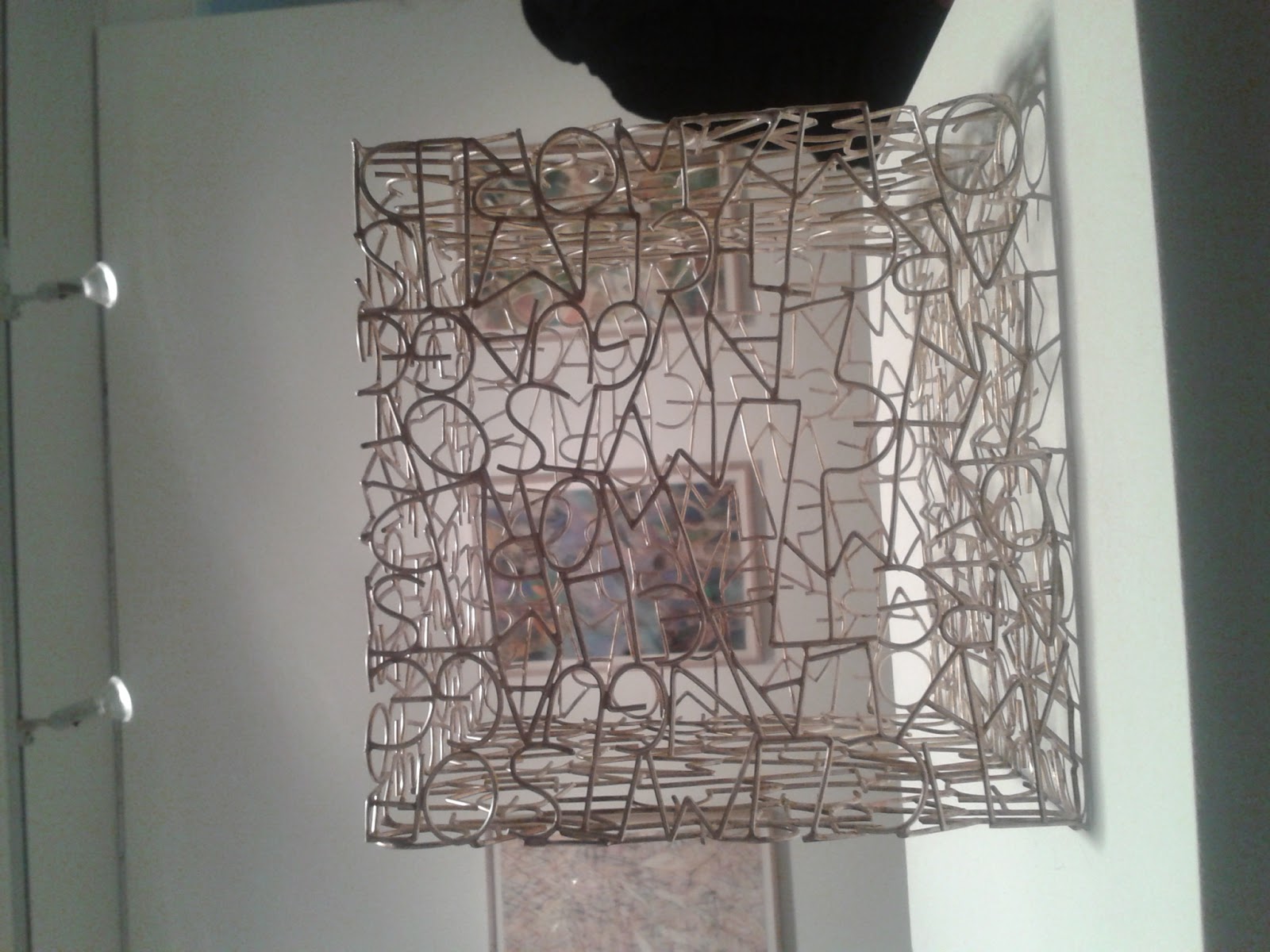
Another word-cube from Tom Philips, this time with text from Wittgenstein, from his new exhibition at Flowers Gallery in Shoreditch.
Monday, 11 June 2012
Francophile/Anglophobe
Marvellous Jubilee-evading break in south-west France over the half-term exploring the countryside and villages around Carcassonne with friends, venturing into Les Montagnes Noirs and the foothills of the Pyrennees. The landscapes are starkly dramatic, sparsely-populated, alive with birds and flowers: the weather was beautiful, hot yet breezy. Well-cooked, locally-grown food - accompanied by decent wine and the odd pastis or two - were never far away.
Deflating, then, to return to work today in chilly persistent rain and wonder what the hell I'm doing in this over-cramped, polluted, hate-infested looney-bin of a city within a country that has not so much gone to the dogs as to the wolves and hyenas, with an amoral blowhard at its helm who's too busy "chillaxing" to notice he's left his 8-year old child behind in the pub.
I was perversely cheered, after getting home wet and exhausted as though my holiday had never happened, to read this remorseless indictment of our pitiful "sinking island", suggesting that as well as being culturally and politically bankrupt, we are also in terminal decline in terms of power and status:
"In the hundred years from 1914 to 2014...the UK will have declined from pre-eminent global superpower to developing country, or "emerging market". The symptoms of this vertiginous plunge in the world's rankings are already starkly apparent: a chronic balance of payments deficit, a looming shortage of energy and food, a dysfunctional labour market, volatility in economic growth and a painful vulnerability to external events."
(from 'Little Britain' by Larry Elliott & Dan
Atkinson, The Guardian Weekend 09.06.12)
Saturday, 2 June 2012
Colossal Rearrangements: Katerina Brac by Christopher Reid
A comment made by Todd Swift the other week at the end of a hyperbolic post about Jon Stone's new volume - "English poetry was perhaps last this differently, oddly smart with Christopher Reid's Katerina Brac" - sent me back to the book in question to check for myself if it was as seminal as Todd implies.
To be honest, I've never given Reid's work much consideration. I confess to being guilty of lumping him glibly in with his fellow Martian, Craig Raine, whose characteristic early poetry seems to me now as much of an outdated 80's fad as the Sinclair C5 and the ZX Spectrum (no doubt some Hoxton retromaniac out there will tell me that these are now the height of cool...) Worse, its over-reliance on flashy, gimmicky tropes at the expense of all other components of poetic meaning or emotional/intellectual/social resonance seems reflective both of the design-over-content ostentation prevalent during the decade and even of the deregulating,brashly acquisitive spirit of Thatcherism underscoring it. (Worse still, Raine continues to write in more or less the same, clever-tricksy manner today.)
Although Reid's first two volumes seemed to be vying with Raine for who could come up with the silliest, most fanciful metaphor (a weightlifter compared to "a human telephone", indeed!), there were always more interesting undercurrents at work even in his most affectedly Martian display. Titles like 'Academy of the Aleatoric' and ' Holiday from Strict Reality' flag up the clear influence of Wallace Stevens, unusual enough for a young English poet of Reid's generation: viewed in the light of the "essential gaudiness" of Stevens' poetry, its linguistically playful dialogue between metaphysical speculation and "things as they are", we begin to discern a persistent philosophical vein in Reid that goes some way to justifying his ludic observational jugglings. It's in this, moreover, that he departs from Raine, whose poems are largely idea-averse, his similitudes amounting to visual puns serving an ultimately descriptive, realist purpose which on scrutiny unravels to a bland thinness of content (the self-defeating aporia of A Martian Sends a Postcard Home, for example, is that why should the recipient know what a mechanical bird or tracing paper is if he doesn't know what a book or mist are); whereas Reid in fact seems more concerned (like Stevens) with the epistemology of seeing or apprehending an ever-shifting reality, and how this is figured in poetic language.
If the early Reid falls drastically short of the scope and depth (not to mention the formal mastery) of Stevens, he was at least mindful enough of the limitations of Martianism to attempt a more sophisticated mode of ostranenye in his third volume Katerina Brac (1983). While the sustained use of a hetronymic persona links Reid (via Hill's Sebastian Arruruz and Middleton's Herman Moon) back to the Pound of Hugh Selwyn Mauberley and Homage to Sextus Propertius, his complex elaboration of an East European poet writing during the time of Communism is refracted through several layers of equivocating distance even these distinguished forebears didn't employ, although the deliberate anachronisms and mistranslations of Propertius might have given Reid his starting-point.
The maladroit translationese of Katerina Brac fosters an off-kilter, wonky manner and rhythm that work in two ways: firstly, as a subtle parody of the often less than felicitous attempts to 'english' East European poets during what Ted Hughes called the "unique tidal wave of poetry translation that swept through English in the sixties and seventies". Few could doubt that this bringing-across of poets like Holub, Joszef, Popa, Celan, Herbert, Brodsky and Milosz (largely promulgated by Hughes and his friend Daniel Weissbort through Modern Poetry in Translation) amounted to an enormously important phenomenon; few also would dispute that a particular overfamilar style - often clunky and ungainly - grew out of the boom (it certainly fed into the purposefully "uglified" poetry of Crow). Secondly, Brac's wryly not-quite-correct-English, intensified by the inclusion (no doubt under the influence of the state censor) of fragments of ridiculous officialese, serves a defamiliarising function which subverts the totalitarian construct of reality she finds herself in.
These quirky, ironic observations on love, history and identity might bring to mind the whole tragic lineage of 20th Century poets who struggled to maintain their writing in the midst of brutal suppression and the obligation to conform to "social realist" tenets of literary value (not least Tsvetaeva, Ahkmatova and Ingeborg Bachmann), but also transcend their (imagined) moment by being rueful insights as resonant to a contemporary audience as to an earlier one. The task of confronting a received and politically-devious state-reality is a constant, Reid seems to imply; especially at the time of the volume's composition when Thatcherite policy was leaning towards a reassertion of top-down hegemony.
With this task (gesturing back towards a Stevensian philosophy) goes the need to recreate a more open-ended and fluid sense of the real through the unpindownable, unlegistated ambivalences of poetic language, like the "pale-blue butterflies" of Katerina's first poem, suggesting "this would be the perfect time/to mend the whole of one's life"; or later in the poem the summer thunder that's like "colossal rearrangements/somewhere at the back of the mind".
Subscribe to:
Posts (Atom)