ictus

ictus
Showing posts with label jh prynne. Show all posts

Friday, 13 April 2018

From Metamorphosis to Molossus: Riley on Middleton

Just came across Peter Riley on Christopher Middleton's Collected in the excellent Fortnightly Review, a book I reviewed myself but I feel didn't get to the nub of as Riley does here:


"there is immense variety, but there is throughout the same pressure in the writing, which pushes the initial material forwards towards a transformation through progressive figures and modes, or sometimes seems to follow a kind of poetical demonstration to reach a condition which was not predicated at the start. Almost all the poems begin from an experience, which is pushed through to a meaning, often by steps which are far from rational or evident, and the resulting meaning can be evasive, or cancelled at the last moment...there is nothing that could be taken as anything but a poem by Christopher Middleton, and this is because of that characteristic restless transformative drive which will let nothing remain at the normative level which makes it possible to get started. The language itself is forced to yield a further and further version of what it is doing until we are somewhere we could not have foreseen, or no longer speak the language with which the poem opened. You could call it metamorphosis: the objects of the poem turn into something else"

Doesn't this hit on a process which occurs in all effective poetry, a "transformative drive" which enacts a corresponding shift within the reader, his or her brain and body and nervous system; certainly a jolt that runs through one's auditory/linguistic proprioception (so to speak)? I also like the fact that Riley - a not inconsiderable poet himself of course - spends quite a while examining the opening poem in the Middleton, 'Objects at Brampton Ash', which was always a favourite of mine (having come across it in the Penguin Modern Poets three-hander in which CM appears - number 4 I believe - before I'd got hold of before any of his full volumes), an enthusiasm apparently shared with RF Langley and JH Prynne.

"The quick thrush cocks his head,/bunching his pectorals" was what got me: the stressed syllables are bunched too, attentive and alert, bristling with assonance, getting ready to launch off into the poem. Also, a metrical feature I always look for (as Charles Tomlinson said that he always looked out for spondees), an example of the molossus - three stresses in a row, an intense compression of pent-up energy which is then furthered by the spondaic impact of head/bunch and only finds release in the run of unstressed syllables in the second line. A whole mimetic drama is played out here just in these two short lines, capturing the transfer of energy the jumpy thrush embodies, asking the reader to cock their head and bunch their pectorals too, ready to take on board both the other objects encountered at Brampton Ash and by extension the whole astonishing world of Middleton's Collected.

Read the poem and Peter Riley's review here.

Saturday, 24 October 2015

Stupendous Cocky Turpitude: Prynne on Podcast

   Like many people, I don't find much time to read these days. I could bemoan the skittering atomistic banality-fest of post-historic consumerdom and our brains' doddering over-reliance on the mental prosthetics of cyber-gadgetry but then Horace was sighing alas that the fugacious years were slipping him by in 23BC. The amount of books on my 'Must Read' list (not to mention the perhaps even longer list of 'Must Re-Read'), however, seems to burgeon in exponential correlation to the dwindling of my reading-time - the resultant line-graph might bear some relation to the same chiasmus besetting contemporary poetry-volumes: never so many being published, never so few bought and read. We are stumbling towards a strange tipping-point in what passes for cultural production where almost everyone is "publishing" something - whether in the form of blog-posts, Instagram photo-feeds, self-published e-books, GarageBand "tracks" uploaded to SoundCloud - but no-one is paying much attention because they're too busy expressing the hell out of themselves. It's like a coked-up party where everyone is speaking at once, tipsily pleased with the sound of their own voice, and no-one is listening.
    Listening to podcasts on my smartphone  while driving is a makeshift expedient, if by no means an actual alternative to reading books. TLS Voices grabbed my attention the other day at the traffic-lights on Finchley Road with an unexpectedly apposite yoking of a non-mainstream poem with a contemporary news-story. Robert Potts' examination of Prynne's To Pollen in the light of the recent media furore over images of the drowned Syrian toddler Aylan Kurdi pointed up the continued incisiveness of the poem's invective, travestying from within a consciously doubling, slippery poetic discourse the linguistic duplicities and slippages that coverage of the two Gulf Wars was almost wholly composed of, laced with the kind of confused post-imperialist xenophobia which informs the rhetoric of many commentators on the recent migrant crisis .
    The silent redaction which transformed the word "immigrant" into "migrant" in permitted news-vocabulary pretty much overnight is a telling example of such semantic drift, although obviously in this case moving away from potentially negativising terminology. (The priggish undergraduate deconstructionist in me wants to signal the denied subjecthood hiding in the banned letters "im/I'm" and to bandy the phrase "interpellated by their elision" to denote the likes of Aylan Kurdi, immortalised now as a tiny dead body washed up on a beach.)

Wednesday, 27 May 2015

Make Some Noise

 Made it along to Café Oto in Dalston the other week for an evening of 'Brighton noise-poetry', an oddly alluring tag for a scene bigged-up in a recent piece for The Wire magazine by one of its proponents, Daniel Spicer. I'd missed the article but had friends who were involved in the performance; the proposition of a live amalgam of poetry and noisy/improvised sounds was inviting too as this kind of interface has always fascinated me.
    We're all aware of poetry's archaic origins as words (or vocalisations) set to music: Nietzsche goes further and suggests that "the poet cannot tell us anything that was not already contained, with a most universal validity, in such music as prompted him to his figurative discourse". We all know the other quotes about literature aspiring to the condition of music and poetry atrophying when it gets too far from music but when we turn to famous poems that purport to be composed in musical forms - Bunting's Sonatas, say, or Zukofsky's "A" or (ho-hum) Four Quartets - you discover, despite a foregrounded musicality of language, that the form is being employed more as a structural analogy than as an actual acoustic principle (as, more impressively, Joyce used the fugue in the 'Sirens' episode of Ulysses) and that on the whole, when compared with the vastly more complex arranging and orchestrating of impalpable tonal textures and ideas which composers have to deal with, poets are little better than apathetic scatterbrains merely writing down the ready-made verbiage they find around them and sometimes counting the syllables and inserting homophonic parallels. Equally, compared with the expressive skill and dexterity born of years of dedicated practice displayed by a concert pianist, a jazz drummer or a Tuvan throat singer, most poets are complacent loafers who merely stand there and read out their lines from a sheet in the funny, over-earnest voice we're all supposed to use.
    Not to say that interesting things haven't been done in trying to marry music and poetry in areas outside the mainstream, white, academic field: I'm thinking mainly here of jazz-, rap- and dub-poetries as well as the sound-poetry of writers like Bob Cobbing and Tracie Morris. Of course, playing with the inherent rhythmical currents and cross-currents of language and being alert to oscillations between sound and sense are what makes poetry compelling in the first place so there is considerable potential to explore links between this and musical collaboration, although the challenge for me remains in transferring the density and complexity of language associated with more page-based poetry (ie. poetry that does not yield all its meaning on a first hearing but bears repeated re-reading and contemplation) into a live context with other auditory materials (as well as performance dynamics) to compete with.
   Although bracing and far from run of the mill, the Café Oto night was a mixed affair for this very reason. Several of the acts fell down on a lack of balance between voice and musical backdrop, both on a sound-engineering level (ie. you couldn't always hear the words) and on a conceptual level, where to me the music was more engaging than the spoken text and therefore distracted me from connecting with the texts properly (extraneous noises, during quieter pieces, were also an issue at times.) The duo Map 71 more successfully welded jagged beats to Lisa Jayne's declamatory utterances, closer in delivery to a female Karl Hyde than any other poet I could name. Alan Hay, sans backing, came across as a performer whose poetry held one's interest on its own merits: mercurial, disarming, with a Frank O'Hara insouciance and fluidity about it though equally tinged with an O'Haran downbeat edge.
   Compared to Hay's aslant beret and goatee, Keston Sutherland came on in conspicuously unbohemian guise: short hair, Todd Swiftian glasses and a pair of those reddish chinos usually only seen on Clapham Common or perhaps at Henley regatta. I'm an admirer of his work, in particular relishing the development from the more demonstrably Prynnean stylings of his earlier poetry to the more recent 'Ode to TL61P' where a more articulately transgressive energy is hit upon. Live, in collaboration with the grime-like beats and discords of THL Drenching (don't ask me what he was playing), Sutherland presents like the Professor of Poetry that he is having an apoplectic seizure and venting random tranches of garbled post-Marxian theory in every direction: ranting, spitting, stuttering and jerking his arms as though to vocally reinforce the already disjunctive intransigence of his texts, delivered at relentless breakneck velocity.
   I stepped out into the chilly Dalston night bewildered as to whether this was one of the most cutting-edge performances by a contemporary poet I had seen or a bizarre and impalatable mismatch. Or both. What it certainly wasn't was a complacent loafer merely standing there reading his lines from a sheet.
http://www.thewire.co.uk/audio/tracks/listen_brighton-noise-poetry-recordings

Friday, 17 February 2012

A Rare Privilege

  Just back from a restorative half-term break in Finland visiting friends, where the intense weather made England’s recent cold snap seem negligible. Despite the chilliness, to be surrounded by depths of powdery new-settled snow blanketing the whole countryside made for some starkly beautiful landscapes, the ideal window-view for the writer who wants to clear his/her mind of urban clutter and try to return to what Stevens calls ‘a mind of Winter’ – ‘nothing himself, beholds/Nothing that is not there and the nothing that is’. It also made me think of the somehow amusing image of monks on a pilgrimage plunged over their heads beneath snow-drifts in the Prynne poem ‘Frost and Snow Falling’ – ‘That /sounds to me a rare privilege, watching/ the descent down over the rim’.

   My friends took me to visit the house of Finland’s national poet JL Runeberg (1804-77), as far as I can gather a sort of Tennyson figure who wrote lots of long heroic epics and narratives about rural hardship. He’s certainly respected in his home-town of Porvoo, where the cafes even sell a rather tasty ‘Runeberg cake’ around the time of his anniversary.(For more information on Runeberg see the link to a very interesting post by Michael Peverett in Comments)

  I've also been trying to engage with more contemporary Finnish poetry through the fascinating anthology How to Address the Fog: XXV Finnish Poems 1978-2002 (Scottish Poetry Library/Carcanet). In most of these poems the unique quality of the Finnish language - with its bristling dots, long compound words and apparently (due to its structure of inflections) a kind of modular connectivity that lends itself to neologism and wordplay - is married to a dark, off-kilter pensiveness that is certainly more akin to Transtromer's work in Swedish or to East European poets like Holub or Popa than to anyone writing in English. No doubt you need a philosophical outlook to get you through such harsh winters: as Sikka Turkka puts it, "I also want to add that snow is a great delight, though I do not understand why so much of it is needed".

Sunday, 3 July 2011

Bizarre Antics

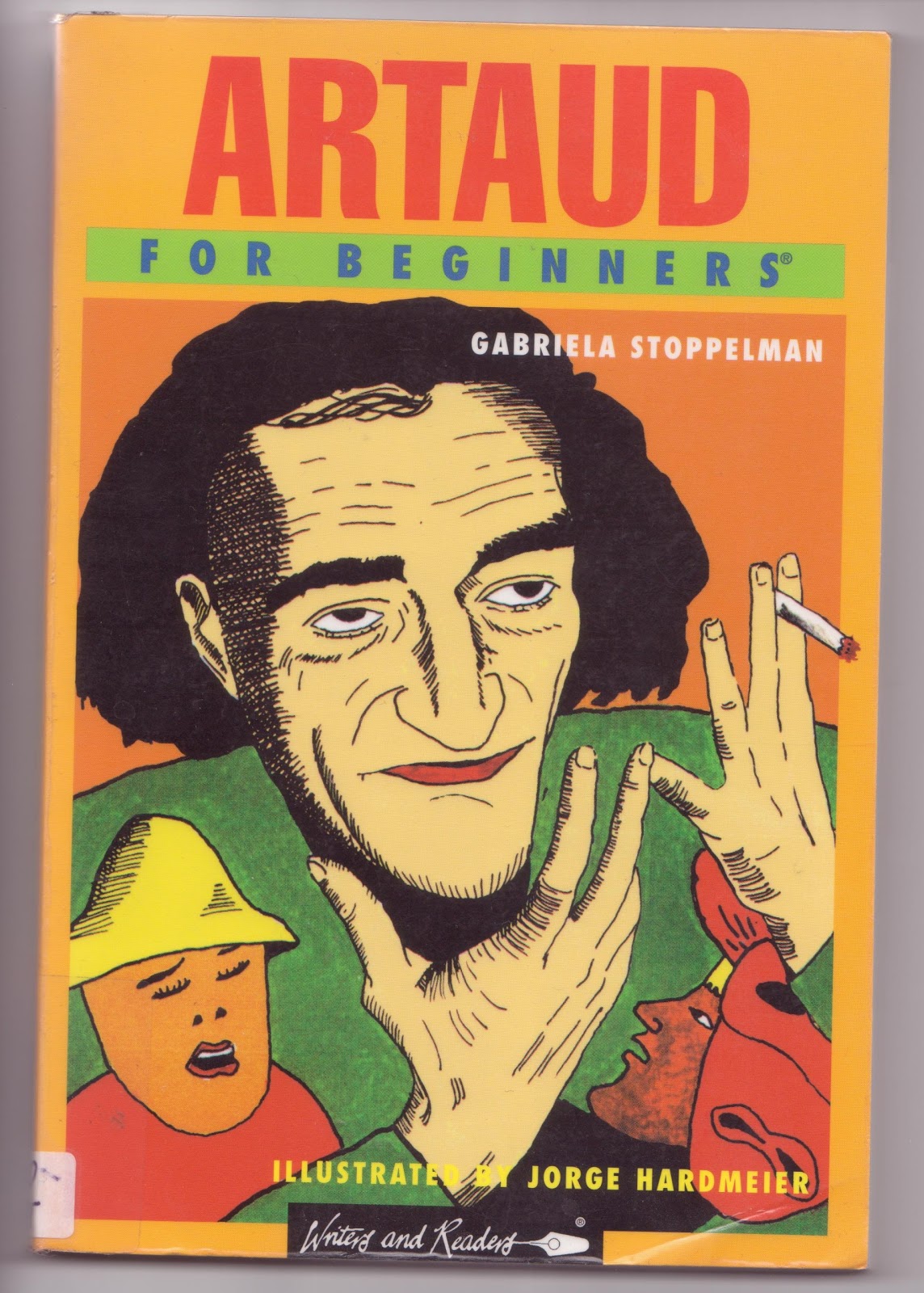
   Came across this in the college library recently, for some reason in the Philosophy section. Its an amusing foray into Artaud's life and work, with line-drawings that make David Shrigley look like Rembrandt and the overall adolescent drift that AA was a misunderstood counter-cultural visionary hounded into madness by the philistine bourgoisie, just like poor old Baudelaire, de Nerval and Rimbaud before him:

 Artaud was an interesting writer and theorist without a doubt, but a lot of his bizarre antics are amusing in themselves. I love the story of him travelling to Ireland in the 30s with a cane he believed was St Patrick's in order to discover the secrets of the Druids: after running out on several unpaid hotel bills and walking through Dublin smiting people with his cane (" My cane imposes silence on my persecutors!") he was finally arrested and sent back to France to be certified.
   Maybe I should follow this model in writing about contemporary poets - how about JH Prynne for Beginners with illustrations by my 9 year old son - " My heterodox vocabulary unravels the cultural hegemonies enshrined in normative discourse!" etc